Analyst Jobs Aren't Disappearing, They're Being Rebuilt
By Entropher · 2026-07-15 · 6 min read
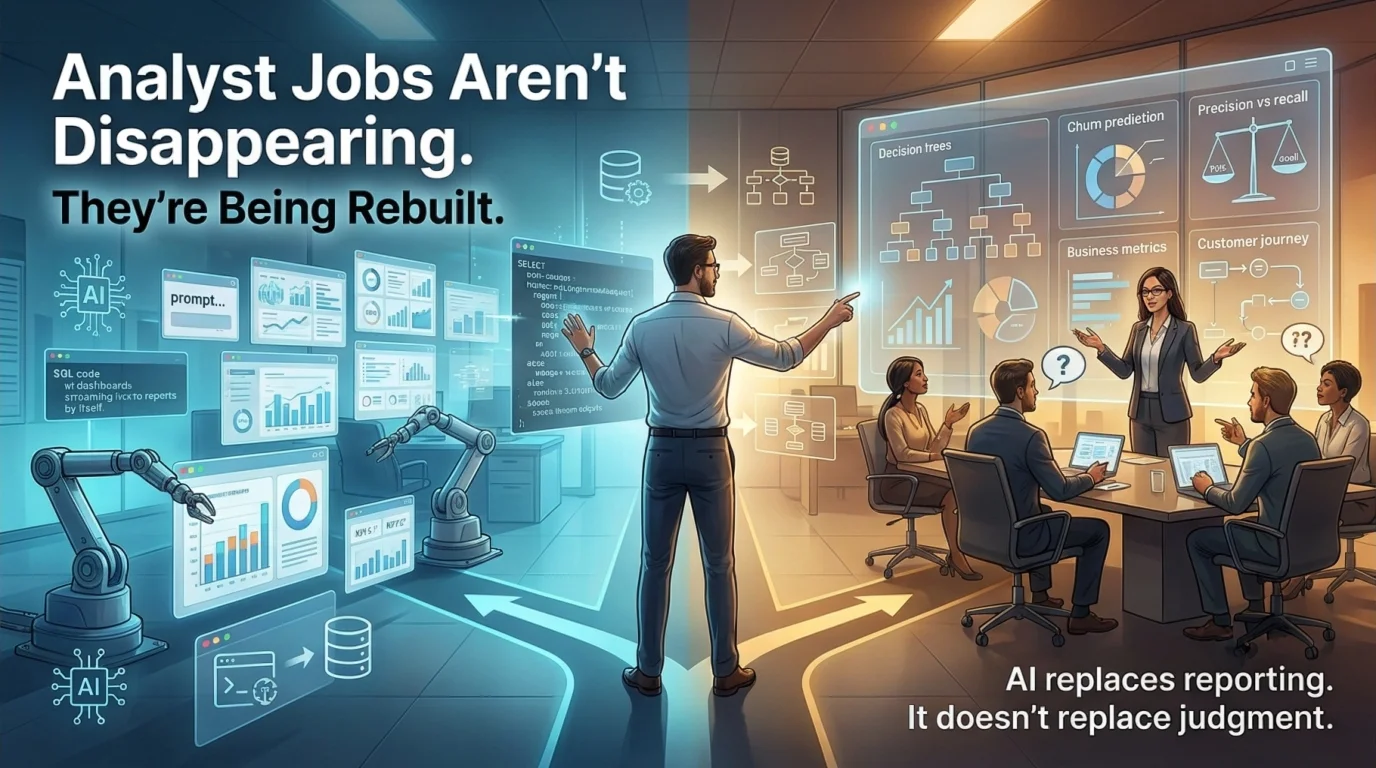
Interview activity for data analysts fell 71% in nine months while the BLS still projects 23% growth. Both are true, and the gap between them is the story: AI is hollowing out the query-writing half of the job and leaving the judgment half more valuable.
Data analytics course at university teaches you pivot tables, clean joins and dashboards. Roll forward a year into the job and a stakeholder asks you to defend a churn model's tradeoffs to a room that would rather hear something else. The query takes ten minutes. The defense is the actual job, and it is the part no course teaches.
Zoom out from that one case and the same split shows up in the hiring data. Most people are reading the wrong headline about it.
There are articles everywhere declaring the data analyst role dead. Layoffs, or a tool that now writes SQL from a plain-English prompt. The story is simple and it is scary, which is why it spreads fast. The market data tells a more specific story, and the specifics are the part that actually helps you.
The contraction is real, and it is uneven
Final Round AI says that data analyst interview activity fell 71% between September 2025 and June 2026, from 3,431 sessions a month down to 1,010. That is the steepest drop of any role in Final Round AI's dataset of more than 816,000 interview sessions. One honest caveat on that figure: it measures activity on a single interview-prep platform, not job postings across the whole market. It is a proxy. But it points the same direction as everything analysts are feeling right now.
Set it against the Bureau of Labor Statistics, which still projects 23% growth for the role through 2032. Both numbers are real, and the gap between them is the story. The long arc points up. The next 12 to 24 months are a right-sizing cycle, companies working off the analysts they over-hired between 2021 and 2023, and the pain is not spread evenly.
It is landing hardest on the bottom rung. Managers with smaller budgets are filling fewer seats and picking people who can contribute on day one, which means they are screening for two to four years of experience under an entry-level title. That is a contradiction early-career analysts read correctly and get rejected by anyway. A Google or Amazon entry-level posting can take hundreds of applications inside 48 hours. The recruiter has thirty seconds and a checklist. If your resume does not match the posting almost exactly, it does not advance, and that has nothing to do with whether you could do the work.
Why AI is doing the splitting
AI writes a competent SQL query from a sentence now. That is real, and it is exactly why the query-writing half of the old job is getting cheaper by the month. Copilot for Power BI, Tableau Pulse, and Gemini inside Looker Studio already generate standard reports from a prompt with no analyst in the loop. The analyst whose value was producing the same weekly report, or a dashboard nobody had to interpret, is the one being automated, and companies know it.
What those tools cannot do is sit in a room and defend why a precision-recall tradeoff is right for one retention team's workflow. They have no read on which stakeholder needs convincing versus informing, or on the history behind a metric everyone argues about. They do not catch the model output that passes every test and still fails the smell test. That judgment work is getting more valuable precisely as the mechanical work around it gets cheaper. The split is not AI replacing analysts. It is AI hollowing out the easy half of the job and leaving the hard half more exposed, and better paid.
This is also who the market is selecting for right now. The analysts getting offers have SQL past the basics, Python they have actually shipped a project in, one BI tool at real proficiency, and a concrete answer when a hiring manager asks how they use AI in their workflow. The ones stuck at the screen have functional SQL, self-reported Python with nothing to show, and interview answers generic enough to fit any company. The dividing line is judgment you can demonstrate, not tools you can list.
What this means for you
If you are entering the field, stop anchoring your identity to the title. "Data Analyst" as a standalone entry-level label is the part absorbing the hit, the same way "Webmaster" got absorbed into front-end, backend, and DevOps twenty-five years ago. The function underneath did not die. It specialized. Anchor yourself to the function instead: the person who turns an ambiguous business question into a number someone can act on and defend. That function will carry a dozen different titles over the next decade. Be attached to the work, not the word.
If you are already mid-level, this is the moment to specialize on purpose instead of by accident. Decide whether you are heading toward the engineering side of analytics or the judgment-and-communication side, and point your next two years at one of them. The generalist who only queries and reports is the profile getting screened out first, in exactly the contraction the numbers describe.
The cruel part of this market is the on-ramp. When "entry-level" postings screen for tools and skills beyond beginner level, entry-level stops meaning entry. New analysts are being asked to show up already operating at a mid-level, and almost nothing in the training pipeline prepares them for that. Courses teach the query. They do not teach the room: how to defend a tradeoff, read a stakeholder, push back on a metric that everyone has quietly stopped trusting, or carry an analysis from a vague ask to a decision someone will actually make.
That gap is the reason I am building DataRunes. Not another SQL tutorial, there are enough of those. Real-world work simulations that drop you into the situations the job actually turns on: the messy brief, the skeptical stakeholder, the analysis where the hard part is judgment and not syntax. The point is to get people ready to enter at the level the market is now demanding, instead of the level courses still train for.
The market is harder. It is not closed. The gap between the analysts getting offers and the ones getting screened out is closable in a couple of months of focused work, and the thing that closes it is not another tool tutorial. It is proof you can do the judgment half: a real project that runs from a messy question to a defensible recommendation.
So decide which half you are building toward, before the shrinking job title decides for you. If you are not sure which side of the split you are on, reply or dm and tell me what you spent most of last week doing or which parts you enjoyed doing. I will tell you which direction it points.
Tags: Career, Job Market, AI, Data Analytics