
How to Think Like a Senior Analyst
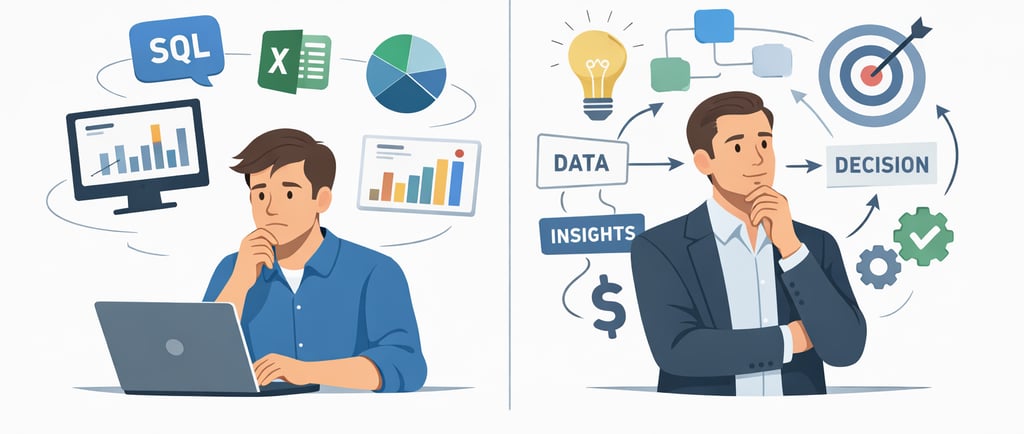
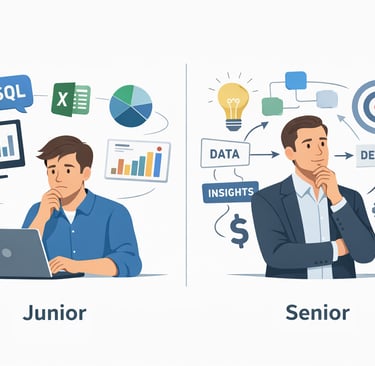
The difference between a junior and a senior analyst isn't the tools they know - it's how they think. Here's what separates the two, and how you can start closing that gap today.
3/11/20264 min read
You just learned SQL. You can write JOINs. You can aggregate data and build decent dashboards. You feel ready.
Then you get the job. Six months in, you notice something uncomfortable.
The senior analyst next to you doesn't write dramatically better SQL. They don't use pandas in ways that mystify you. Their dashboards aren't always prettier. But somehow, they are trusted with bigger problems. Their findings lead to actual decisions. When they present to leadership, people listen.
What do they have that you don't?
The gap between you isn't technical. It's how they think.
Here are five habits that separate junior analysts from seniors and how to start building them now.
1. Juniors answer questions. Seniors ask clarifying questions.
A stakeholder walks up and says: "Can you pull the conversion rate for last month?"
A junior analyst opens their SQL editor.
A senior analyst asks: "Sure - what are you trying to figure out?"
That one question changes everything. Because conversion rate is a ratio, and ratios hide a lot. Are we talking website visitors to signups? Leads to paying customers? Trial users to annual subscribers? The answer to each is different, and the story behind each is different.
Senior analysts understand that the question they receive is rarely the question that actually needs answering. Their instinct is to go one level deeper before they go to the data - not to be difficult, but to avoid spending three hours pulling the wrong number.
Habit to build: Before writing a single line of code, write one sentence - "I think the actual question here is..." Then check with the stakeholder.
2. Juniors trust the data. Seniors interrogate it.
This is the mistake that gets junior analysts burned - sometimes publicly.
You pull a report. The numbers look fine. You hand it over. Then someone in the meeting points out that a major data pipeline broke two weeks ago and half the records are missing.
Senior analysts assume something is wrong until they've verified otherwise. They check date ranges. They look at row counts. They compare current numbers to what they'd expect based on historical patterns. They ask: does this make sense?
It's not paranoia. It's calibrated skepticism built from experience watching data quietly lie.
Clean data is the exception, not the rule. The analyst who assumes otherwise will eventually embarrass themselves in front of a director.
Habit to build: Add a "sanity check" step to every analysis. Look at the extremes, the nulls, the totals. Compare to last period. If something feels off, it probably is.
3. Juniors report numbers. Seniors build context.
A junior analyst answers the question and closes the ticket.
A senior analyst answers the question, then adds: "While I was looking at this, I noticed something else you might want to know."
This is one of the most powerful things an analyst can do - and it's almost impossible to teach directly. It comes from genuinely understanding the business, not just the data model.
Senior analysts know what their stakeholders care about. What the targets are. What conversations are happening at the leadership level. So when a number looks slightly off, or a trend breaks in an unexpected direction, they recognize it, even though nobody asked them to look.
This is how analysts build a reputation. Not by being faster at SQL. By consistently making people think: "This person makes me smarter about my own business."
Habit to build: Spend time learning your stakeholders' goals, not just their data requests. What are they being measured on? What would make their quarter a success? Once you know that, you'll start seeing relevant signals they haven't thought to ask for yet.
4. Juniors explain what happened. Seniors explain why it matters.
There is a version of analysis that is technically correct and completely useless.
"Revenue was down 12% month-over-month."
Great. And?
Senior analysts don't stop at describing the data. They push toward interpretation and implication. Revenue dropped - but is that seasonal? Is a specific segment driving it? Has this happened before, and if so, what happened next? What should the business do differently?
This shift - from describing to interpreting - is the difference between an analyst who produces reports and one who produces decisions.
Data tells you what happened. Analysis tells you what to do about it.
Habit to build: When you finish an analysis, write the one-sentence "so what" first. If you can't write it, you don't understand your own findings yet.
5. Juniors learn tools. Seniors learn patterns.
This is perhaps the most important mindset shift of all.
Junior analysts often think about their career in terms of tools: I know Excel. I'm learning SQL. I want to learn Power BI. Python is next. The more tools I know, the more valuable I am.
There's nothing wrong with this - tools matter. But senior analysts think differently. They think in patterns.
They know that the logic behind diagnosing a revenue drop is the same whether you're using SQL, Python, or Excel: start broad, narrow by dimension, identify the segment driving the change, check for data quality issues, then characterize the trend.
That pattern doesn't change. The tool is just the vehicle.
Once you think in patterns, you become dangerous. Because patterns transfer. A new company, a new industry, a new tech stack: you're effective faster than someone who is merely fluent in the tools.
Habit to build: After every analysis, ask yourself: what was the underlying thinking pattern here? Could I apply this same approach in a different context? Then write it down.
So What Does This Mean for You?
If you're early in your analytics career, here's the honest truth: you probably need to spend less time worrying about your SQL and more time developing your judgment.
That means:
Asking better questions before you open any tool
Building skepticism about data as a default habit
Learning your business context, not just your data model
Practicing interpretation not just description
Thinking in patterns that outlast any single tool
None of this is fast. Senior analysts develop these instincts over years of getting things wrong, watching decisions fail, and building a calibrated sense of when to dig deeper.
But you can accelerate it deliberately.
Every time you submit an analysis, ask:
👉 Did I ask clarifying questions?
👉 Did I check what might make this wrong?
👉 Did I build context, or just answer?
👉 Did I tell them what to do, not just what happened?
👉 Do that consistently, and you'll compress five years of growth into two.
Most analytics courses focus on tools. SQL syntax. Dashboard buttons. Python libraries. Those things matter, but they're not what makes a good senior analyst. The real career advantage comes from something else - analytical judgment.
That’s exactly what we’re building with DataRunes. A platform designed not just to teach tools, but to train the thinking patterns behind real analytical work.
© 2026. All rights reserved.